

Yesterday, Ezra Klein released a podcast interview with Bill Gates about Bill’s concerns over the future of AI. This interview stood in sharp contrast to his interview last week with Nvidia’s CEO Jensen Huang. Huang was quick to pooh-pooh any concern over AI, with lines about product liability being enough of a market force to keep companies from releasing dangerous AI. Bill said he couldn’t even listen to that argument with a straight face. He said that AI is already incredibly dangerous and has been since about mid 2026, when Mythos and Fable made it possible to autonomously build and find bugs in incredibly complex software systems. (He also lays out these views in a recent essay, “The Turbulent AI Era Is Here.”)
He uses AI extensively. He’s optimistic about AI’s potential, but he’s alarmed at our collective lack of seriousness in addressing AI’s present dangers. There were three things he talked about that are worth exploring more deeply: whether we’ll face widespread job displacement, what to do about it if we do, and what to do about the already dangerous capabilities that AI gives to bad actors.
On the first one I agree with him, and we both are in agreement against the prevailing winds of AI business and political leadership. On the second two, I disagree. Let’s dive in to each one.
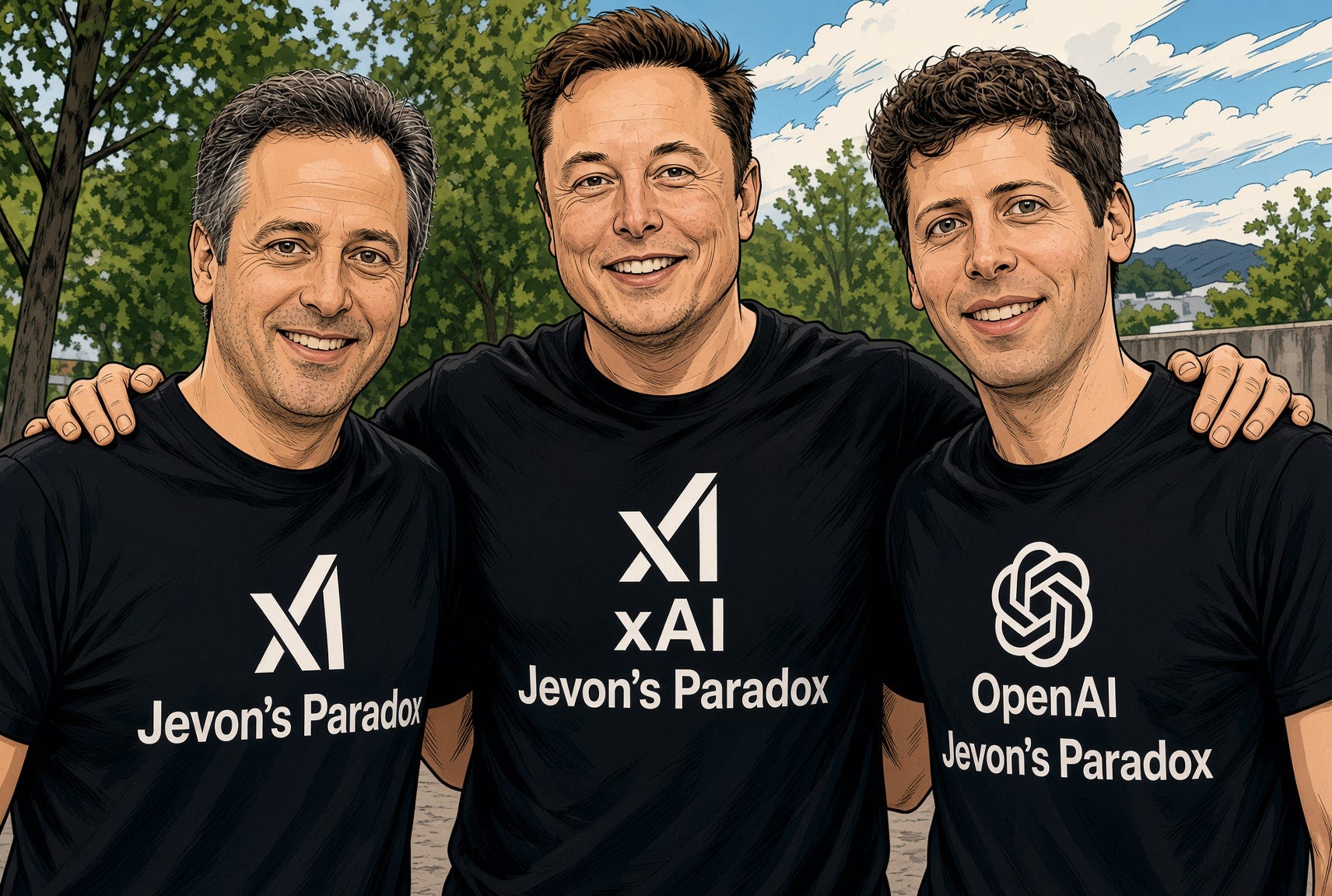
Elon Musk, Jensen Huang, and most famously David Sacks argue that fears of job displacement are overblown. “Jevons’ Paradox!”, they say. Gates argued that Jevons’ Paradox doesn’t really apply in the way that accelerationists think.
He’s right. Let’s quickly review how Jevons’ Paradox works. If you make something in a system more efficient, you sometimes get a surprise: people use or extract more from the system than they used to. An example is making a car engine more efficient. You do that, and some of the gas you expected to save gets burned anyway because people drive more. In some cases total consumption even goes up. Dang it! We were trying to save the planet and we made things worse.
But it turns out there is no paradox here. There’s just good old supply and demand. And some demand is elastic. When demand is elastic, increasing the supply will cause people to buy more of the thing. In the case of the efficient motor, it wasn’t gasoline that the demand was elastic for, it was mobility. By increasing the supply of that mobility, making it cheap enough that certain trips that used to be cost prohibitive are no longer prohibitive, people used more of it.
Can you see that this doesn’t work with AI? If you make cognition cheaper, will we use more cognition? Absolutely. But that has nothing to do with the source of the cognition. The demand curve will want more of the cheap stuff (AI), not more of the expensive stuff (human thinking). Maybe there are ancillary things that the cheaper cognition will enable, like more human-to-human salespeople. The steel man version of the accelerationists’ case is that human work complements AI. Someone still has to exercise judgment, take responsibility, and earn the customer’s trust, and more powerful, more widely distributed AI could increase demand for that. Sure. That could be true. I just don’t think it covers nearly as much of what people get paid to do today as the accelerationists imply, and the relationship between that new work and the increase in use of cognition is not at all guaranteed to be linear. And certain things that we use cognition for do not have elastic demand. We only need so much tax preparation. We only need so many support tickets closed. So if the bet is that the new work created by the increase in the use of cognition will cover all the jobs that we lost, we have no way to actually know it ahead of time, and you can’t summon Jevons’ Paradox to prove it.
He recommended two fixes for the coming job displacement. First, human reserved jobs. He gave examples in teaching and healthcare. I’ve got really no argument there other than that if those are the only available jobs, the supply of people willing to perform them will be outrageous, so the wages probably won’t be all that great.
The second was a tax on robots and tokens. The problem is that a tax on inputs pushes companies toward less efficient ways of producing the same value. Compute can move to wherever the tax is lowest. And the tax lands on whoever uses AI rather than whoever captures the value it creates. If AI keeps getting cheaper per token (which it currenlty is at a rate of 66% per QUARTER!, the rate would also have to keep rising just to raise the same revenue from the same amount of value created.
The only real way to make a tax that works is to tax the value (the profits). But that’s a politically uncomfortable conversation. How are we to decide who deserves the profits? In capitalism, labor is simply a requirement, and businesses were free to decide how much profit to forgo to buy their labor in a competitive market. Without competition, there would need to be some way to determine what profit share non-employees should get.
This might sound circular. How can you use a business’s profits to pay people and then expect those people to buy that business’s goods and services? But capitalism already works this way. Wages are paid from money that would otherwise be profit, and workers spend those wages at the businesses that pay them. Asset owners already spend their profits the same way. So the circularity can work. The hard part is the politics of deciding how profits get distributed to the many.
The third item is that Gates argues that we already have a thing more dangerous than a nuclear bomb, and we’re just letting anyone use it. His examples are that a bad actor could use existing AI to build cyber or bio weapons that could already cause more devastation than an atom bomb on a big city. And to be fair, COVID killed 15 million people worldwide, so if a bad actor could make a new COVID, it would absolutely be more dangerous than a nuclear bomb. He’s angry that no one is regulating or deciding who can use this thing.
This may be true, but the analogy is horrible. Nuclear bombs did not empower individuals in any way whatsoever, so there was no demand from individuals to be able to access their own nuclear bombs. AI does empower individuals, and the demand for AI is unlimited (re highly elastic) from both businesses and individuals. So if someone gets to decide who has access to what AI at what capability, that, again, is politically fraught. Do you have to work for the government or a certain corporation? Do you have to be licensed? Does getting a license have a cost that prevents some people from obtaining it? Do you have to live in a certain country?
This isn’t hypothetical. In June, U.S. Commerce Department export controls led Anthropic to suspend access to Mythos and Fable for nearly three weeks. The most capable Mythos model is still available only to a small group of vetted organizations picked by a private company (Anthropic) with unclear involvement by the US federal government. So, someone is already deciding who gets access. We, the people, just didn’t get a say.
So while it’s true that AI has the potential to be big and bad and widely dangerous (bioweapons, cyber attacks, etc.), regulating it also has the potential to create a new system of haves and have-nots that runs counter to fundamental liberal beliefs (the “we hold these truths to be self evident” types of beliefs). I should say that I have a stake here. My company, Kelsus, deploys open-weight models for financial services firms, and open-weight models are the hardest kind of AI to control access to once they’re released.
Directionally, I’m more aligned with Gates than I am with David Sacks. Gates is clearly more thoughtful and well read on the subject. But I’m afraid that his hopes for a regulatory framework will run up against the values of liberal democracy.
It feels quite likely that we’ll have to make tradeoffs that will be really uncomfortable. If the main way to stop someone from using AI to build a bioweapon is to watch how AI is being used, then AI abundance might come with significant government surveillance. If the main way to stop AI from breaking the economy is to distribute profits to non-employees, then AI abundance might come with significant government wealth redistribution.
Honestly, if you have ideas for how to have both freedom and superintelligence (and don’t just throw around Jevons’ Paradox like some kind of talisman), please let me know in the comments or with a reply.
Thanks for reading!
—Jon Christensen
Great article, Jon! Need to push back on the statements that you made about the need for human labor being finite, i.e. "We only need so much tax preparation. We only need so many support tickets closed." If AI was exclusively used to automate the way the world currently operates, your statements might be true. If, however, AI substantially transforms our lives, the market elasticity is much greater, e.g., extended life expectancy with a corresponding global increased demand for goods and services, exponential employment opportunities in frontier industries like building, training and maintaining robots. The invention of the printing press, the Industrial Revolution, and the Digital Revolution did not increase global prosperity because of greater demand for what already existed; they dramatically changed how the world worked. The challenge is that we do not have centuries, decades or even years to wait for the AI abundance pendulum to swing. Organizations should not be downsizing for the promise of AI; they should be retaining and reskilling their talent (and supplementing them with AI proficient entry level workers) to quickly respond to predictable (and unexpected) market shifts.